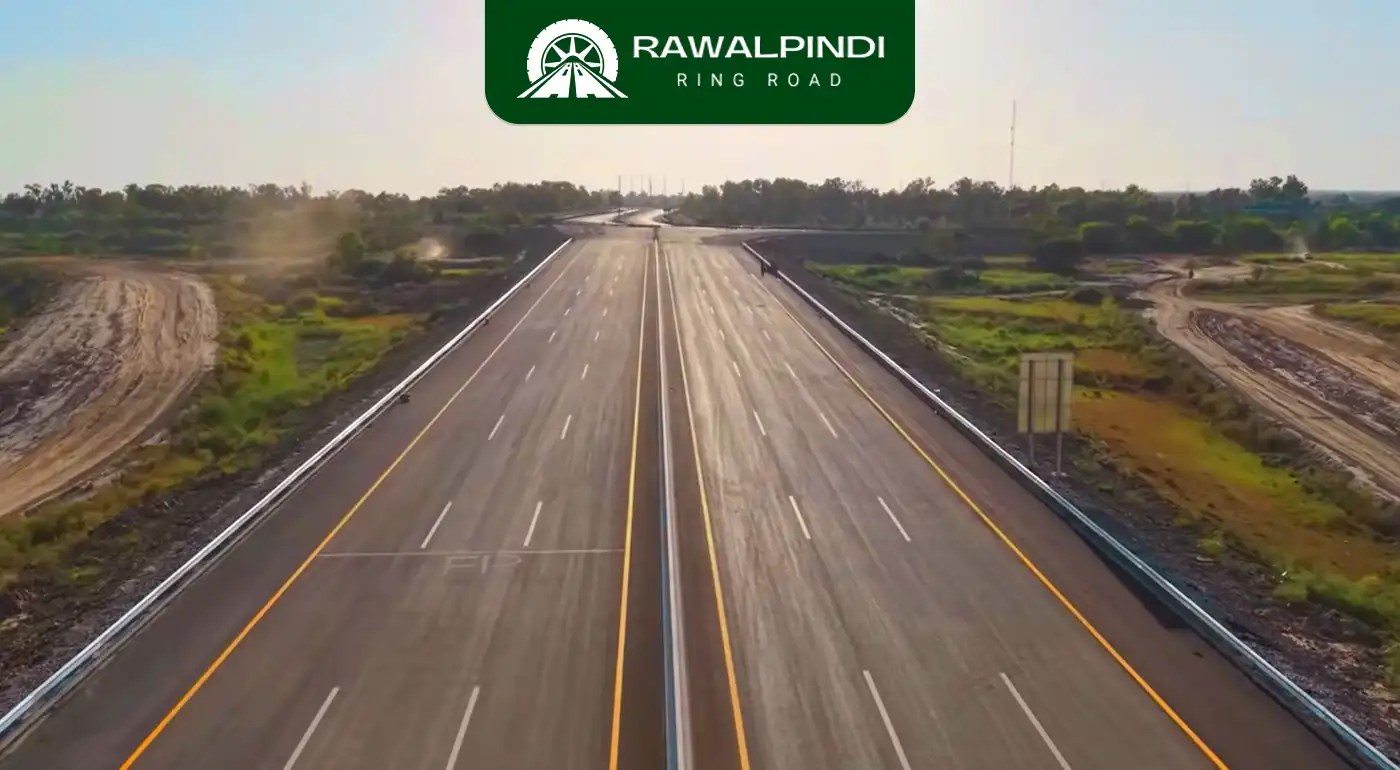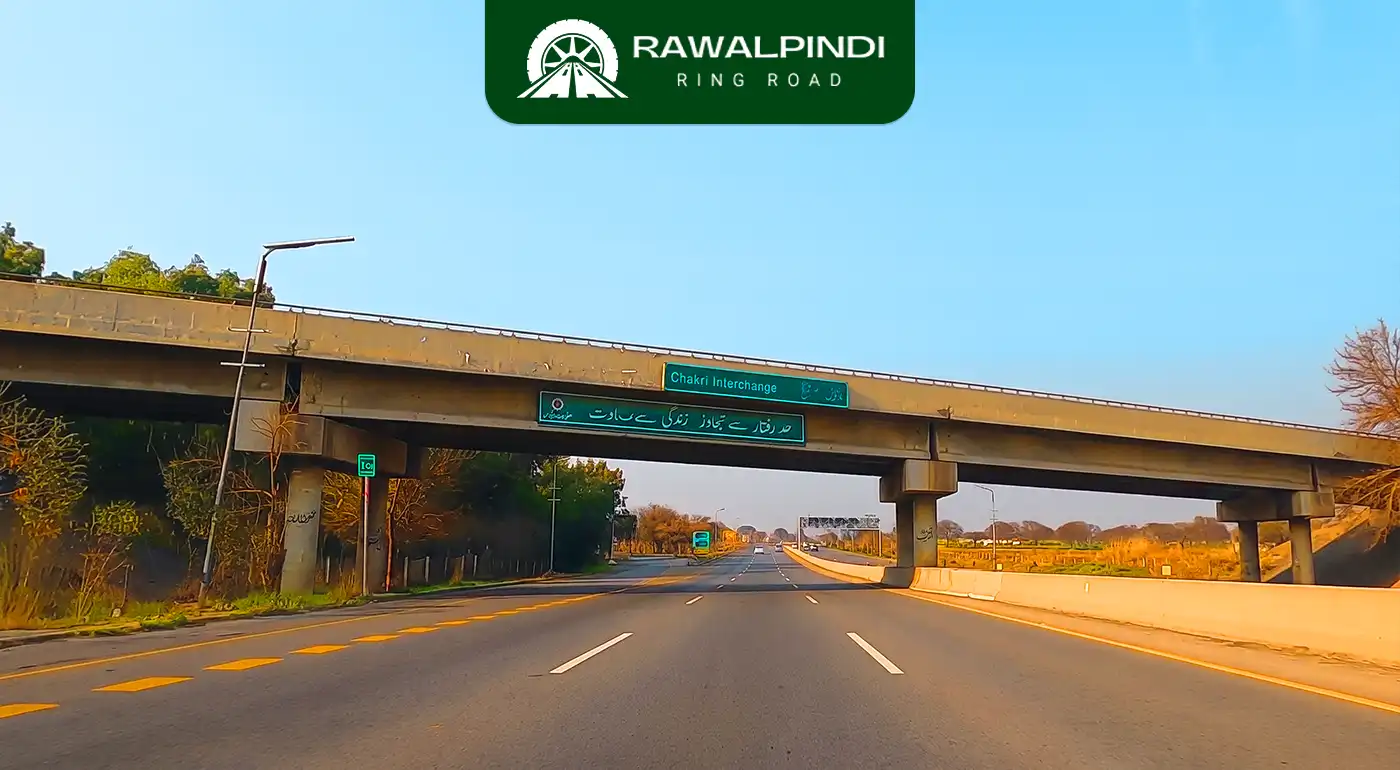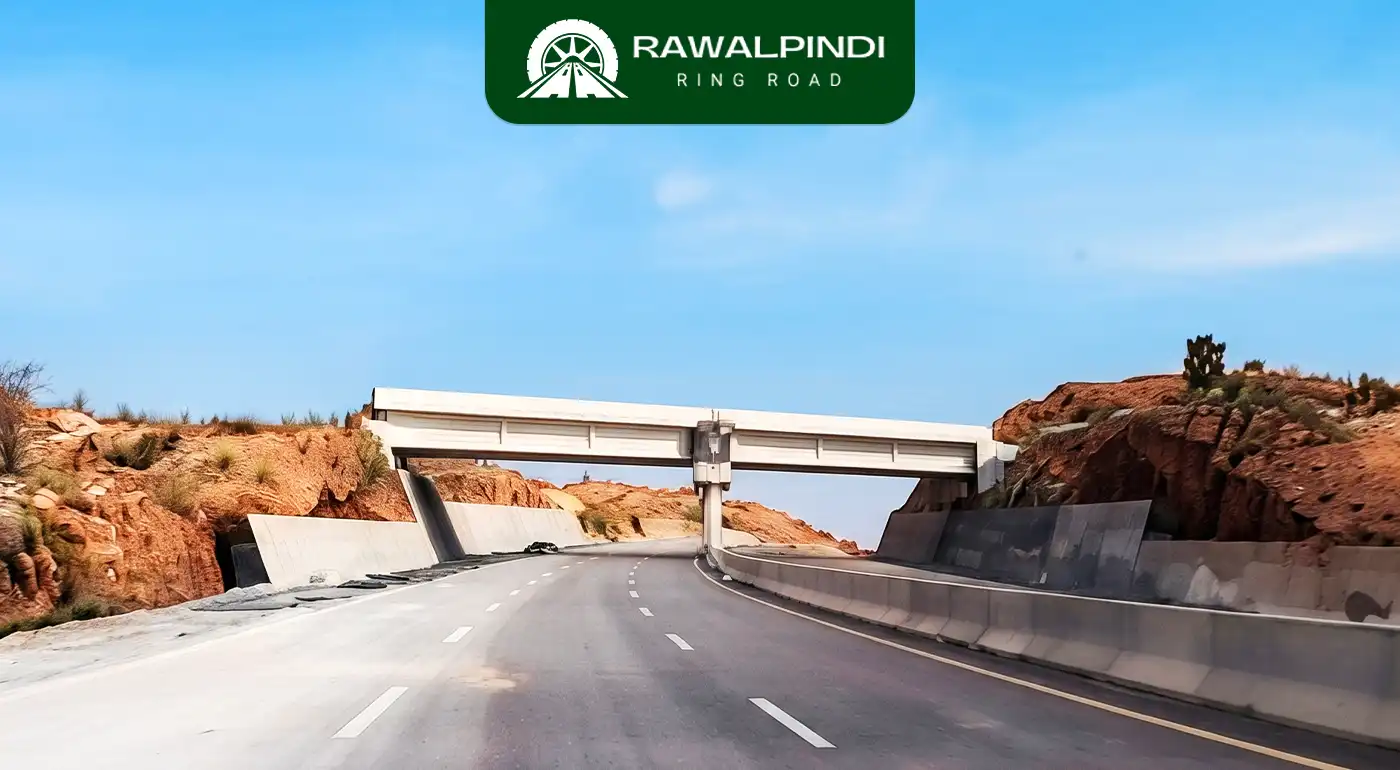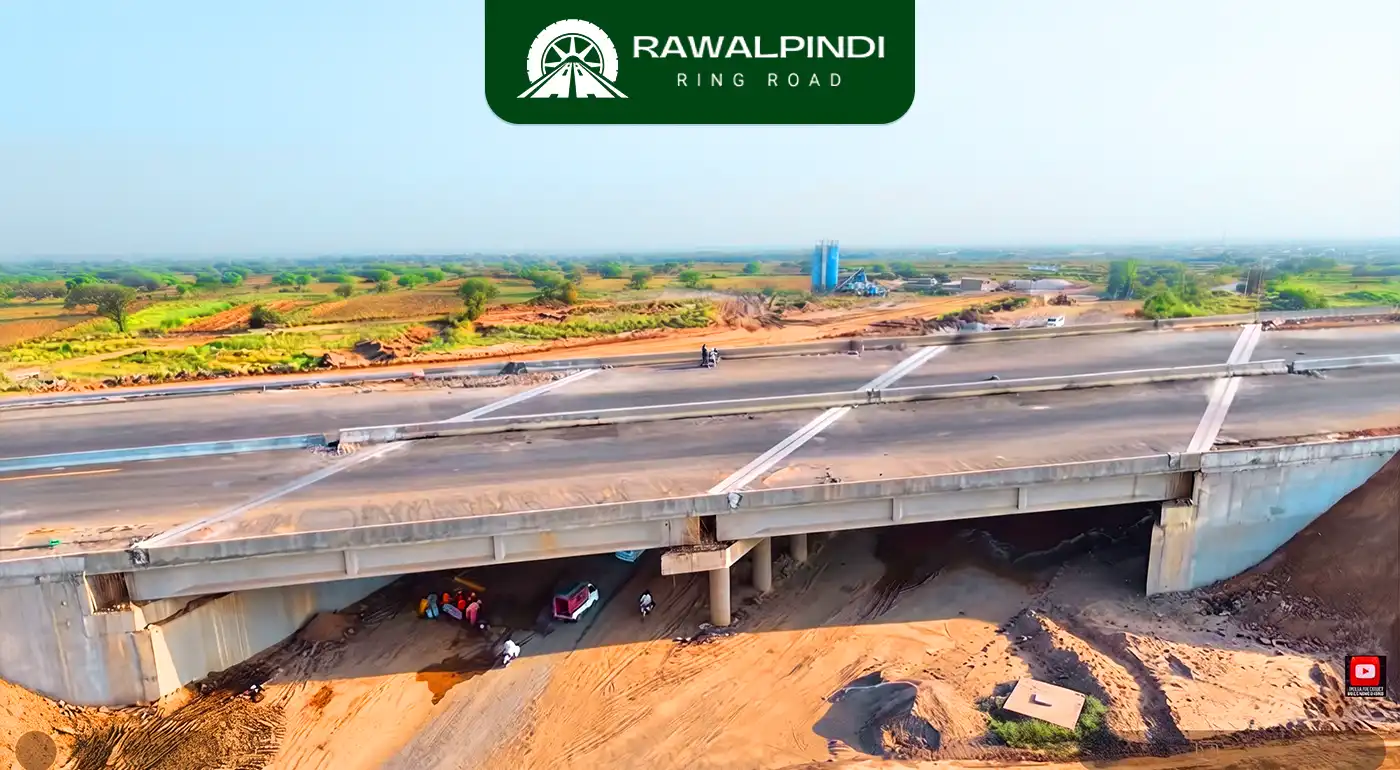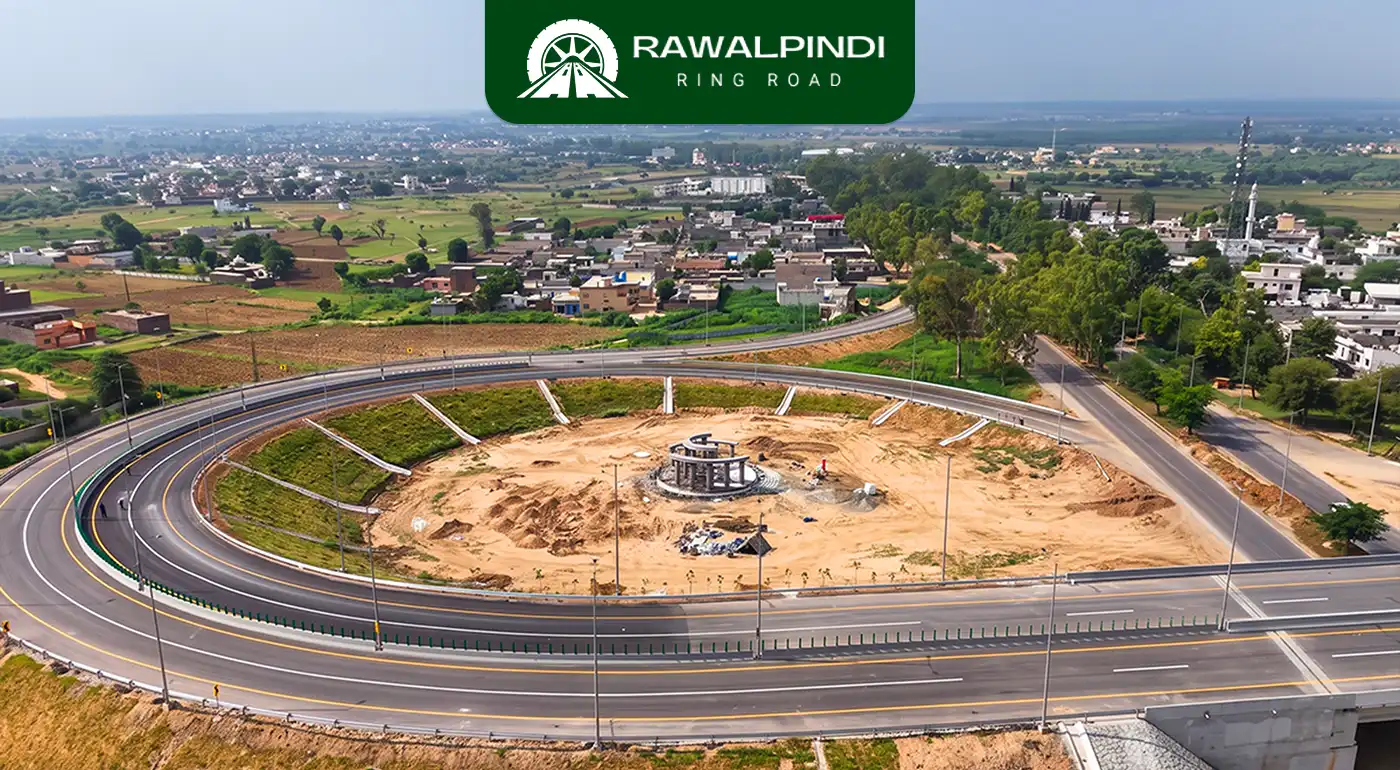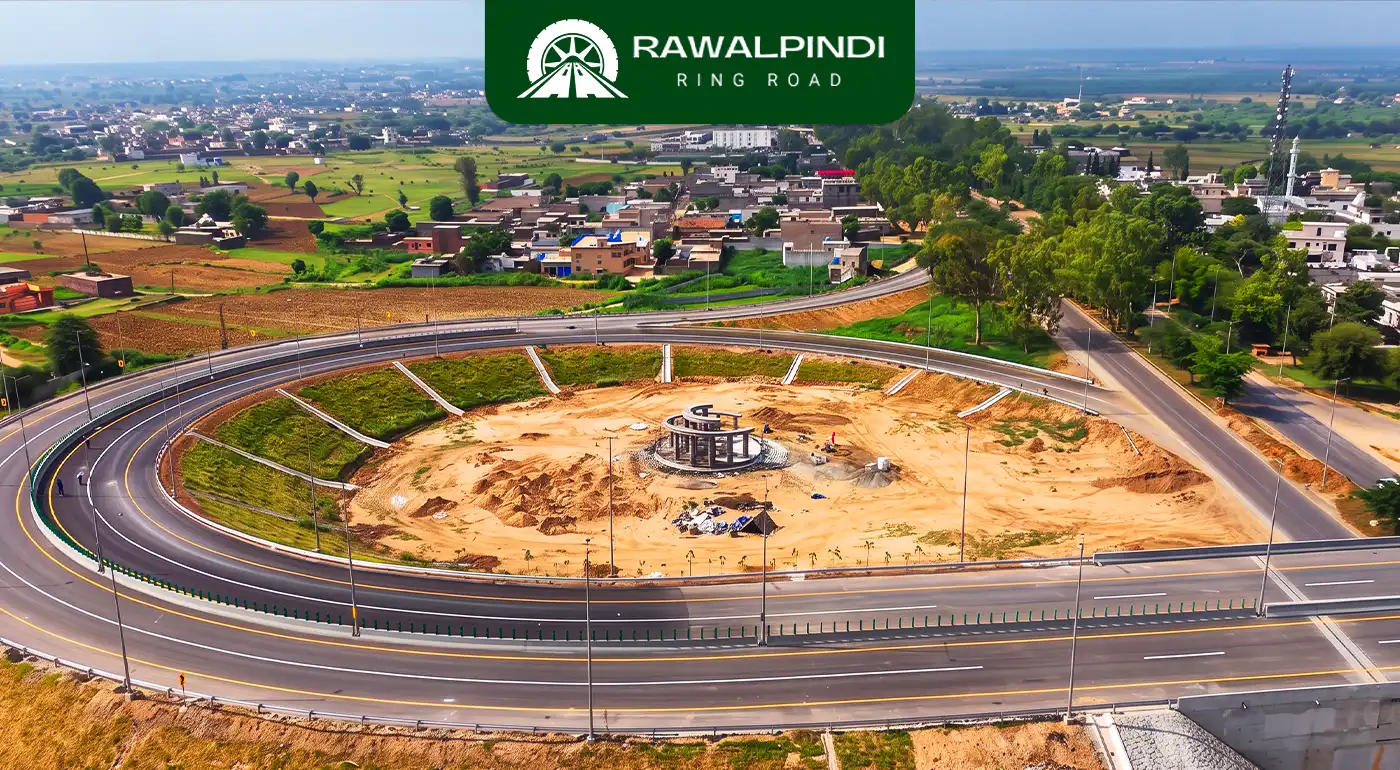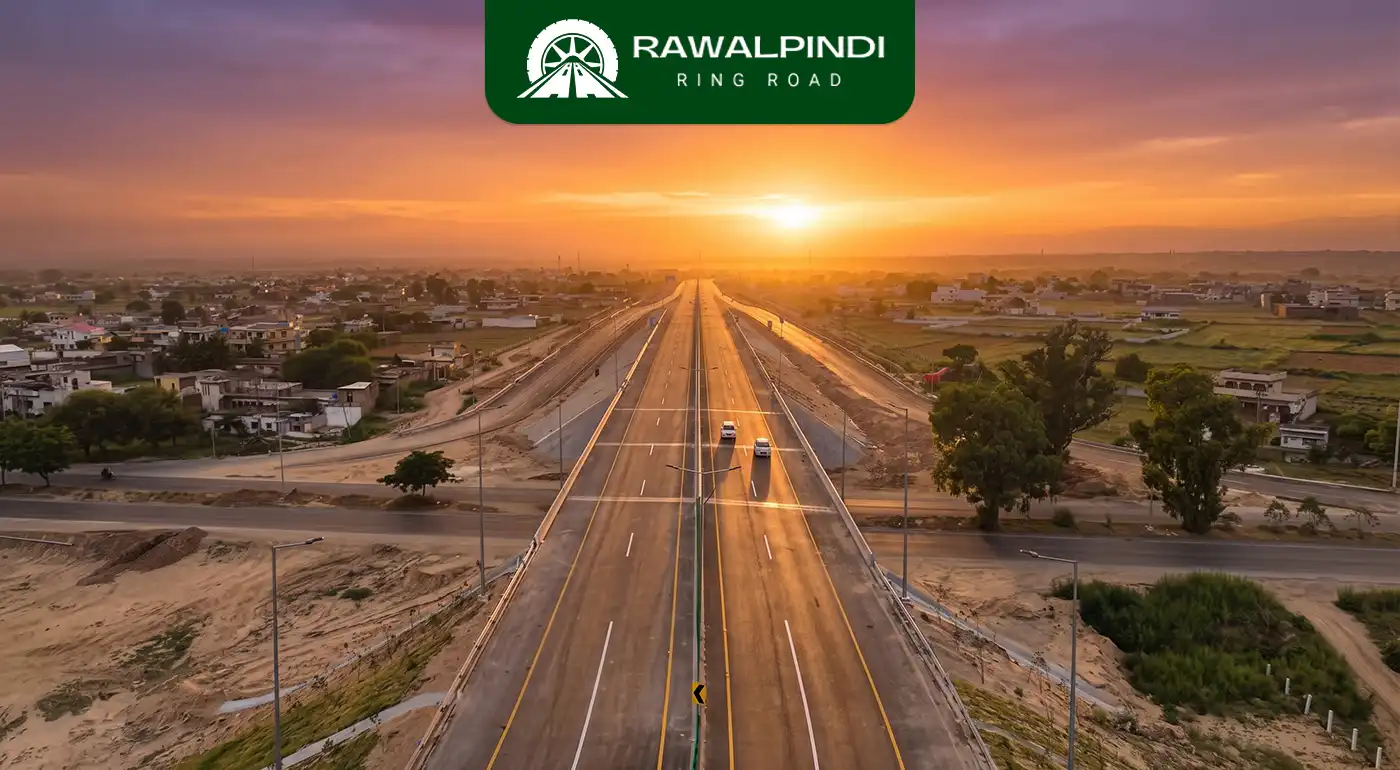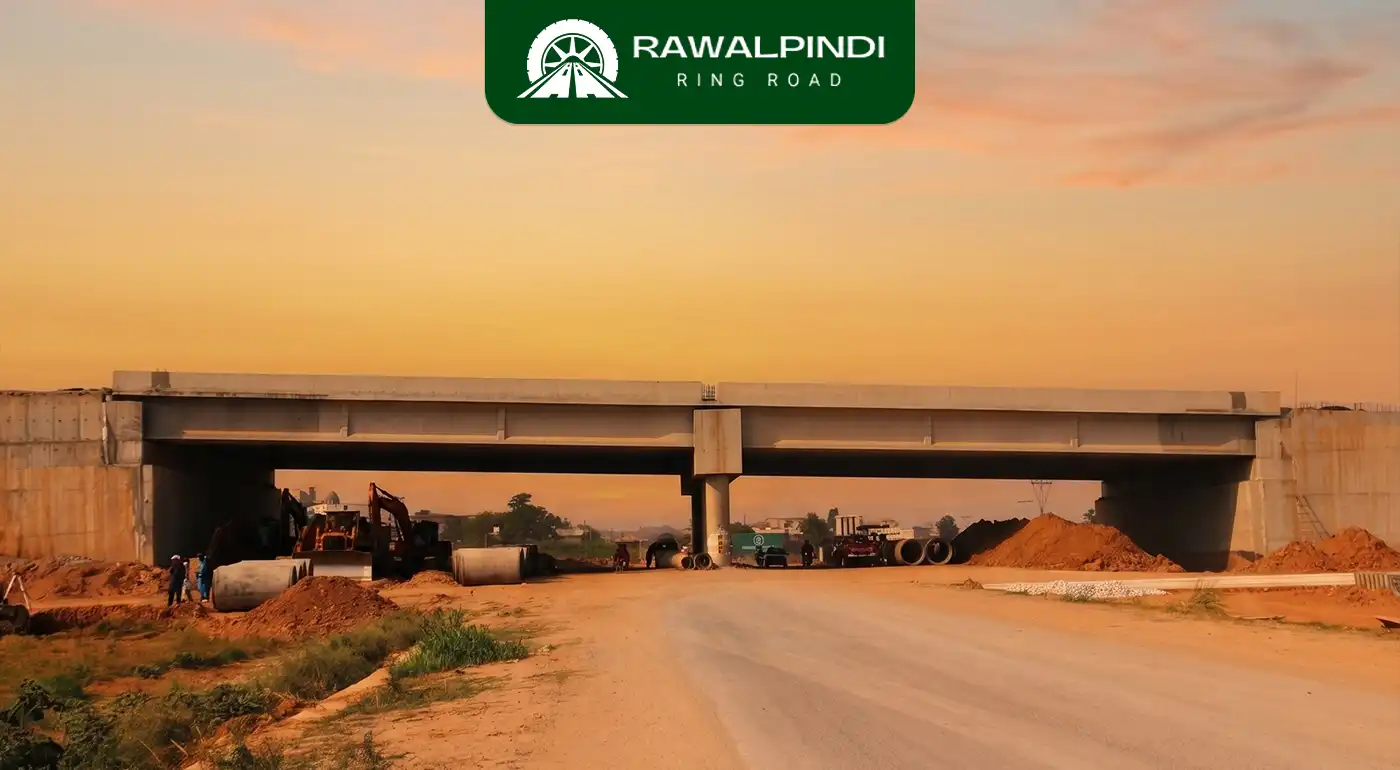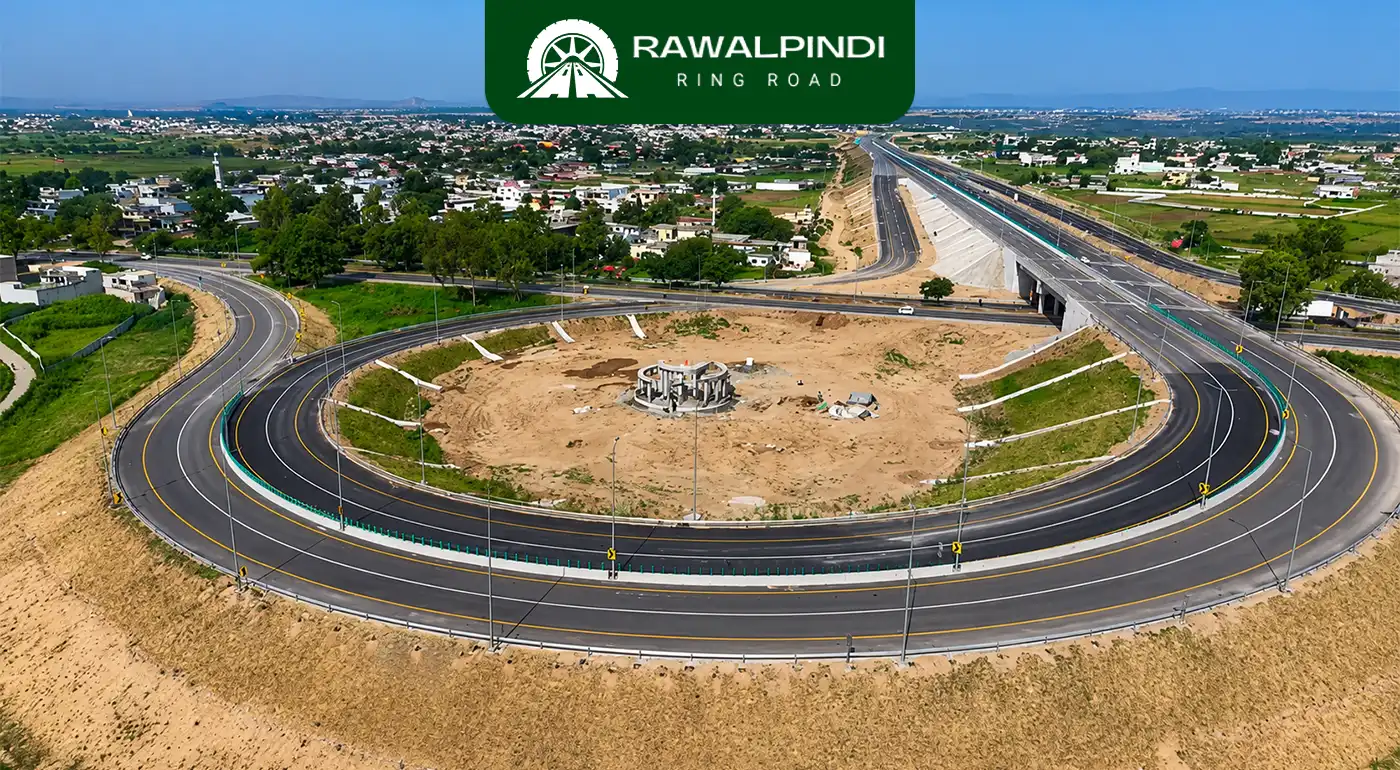
The Rawalpindi Ring Road (RRR), also called the R3 Project, is a 38.6 kilometre controlled-access expressway being built to divert heavy and intercity traffic away from Rawalpindi’s city centre. It connects GT Road (N-5) near Rawat in the east to the Lahore–Islamabad Motorway (M-2) at Thalian in the west, running through the Potohar Plateau and passing through Chak Beli Khan, Adiala Road, and Chakri Road along the way.
Despite the name, it is not a complete ring. It is a linear bypass, a point-to-point corridor designed as a missing link in the region’s road network.
Quick specs:
- Length: 38.6 km
- Lanes: 6 (three on each side)
- Design speed: 120 km/h
- Right-of-way: 90 metres
- Interchanges: 5
- Contractor: Frontier Works Organisation (FWO)
- Executing agency: Rawalpindi Development Authority (RDA)
- Total project cost: Rs 46.64 billion (excluding Thalian interchange) to Rs 51.4 billion (including Thalian)
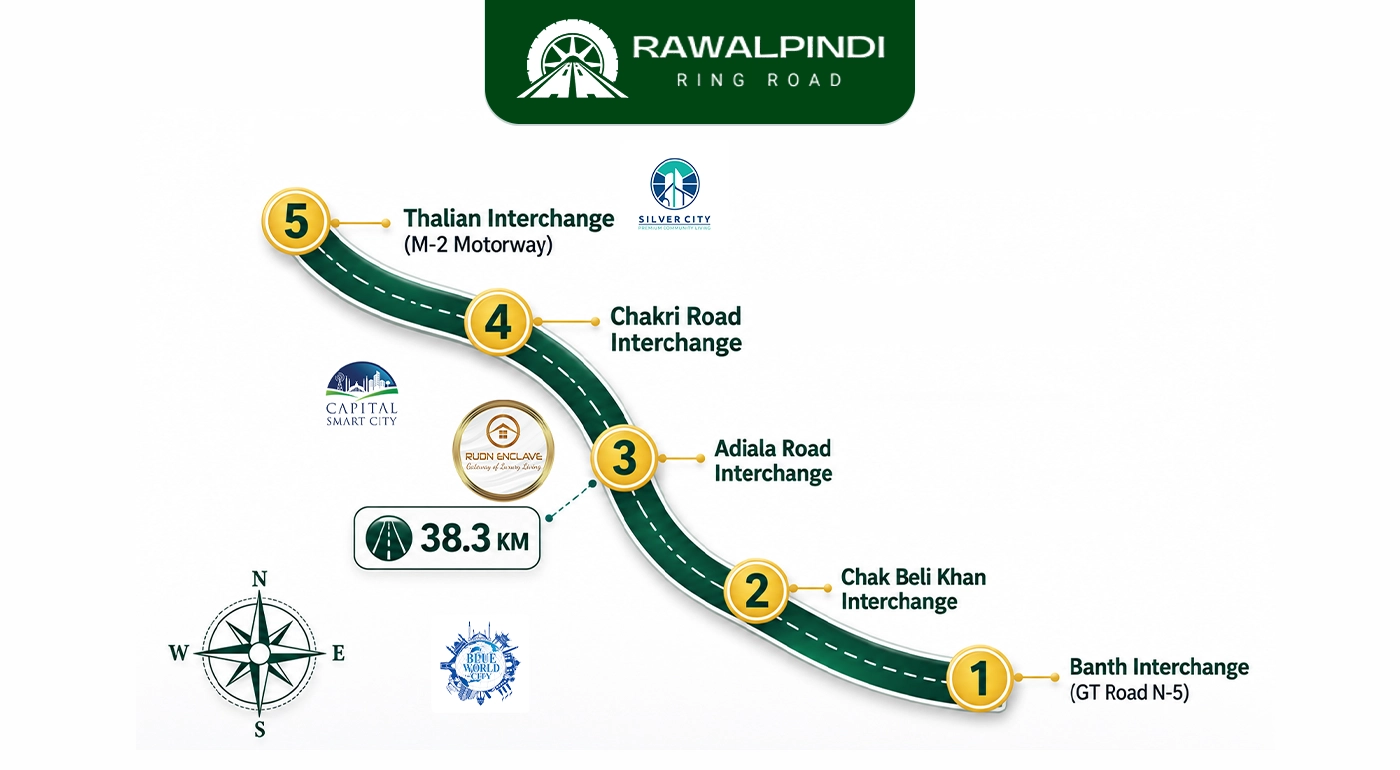
Rawalpindi Ring Road Map
The route runs east to west across the Potohar Plateau, starting at Banth on GT Road and ending at Thalian on the M-2. The five interchanges and their local names are:
Interchange | Local Name | Access Road | Status | |
1 | Banth | Banth Mor | GT Road / N-5 | Complete |
2 | Chak Beli Khan | Maira Mohra | Chak Beli Khan Road | Complete |
3 | Adiala Road | Khasala | Adiala Road | Complete |
4 | Chakri Road | Kolian Parrh / Maira Shareef | Chakri Road | Complete |
5 | Thalian | — | M-2 Motorway link | Phase II — pending |
Rawalpindi Ring Road Deadline and History
The Ring Road was supposed to open in 2025 end but due to plan revisions, design upgradations, increasing cost kept deferring the project.
Deadline set | Deadline date | Completion at that point | Why it was missed |
CM Maryam Nawaz site visit | 30 December 2025 | ~75% | Stone supply disrupted by GT Road overloading ban; Thalian interchange added late; revised PC-1 still pending |
Divisional review meeting | 30 March 2026 | ~80% | Thalian interchange design upgraded to broader format, increasing scope and cost; revised PC-1 approval delayed |
Rawalpindi commissioner review | 30 May 2026 | ~85% | Thalian interchange work and finishing tasks still pending |
Commissioner Aamir Khattak review | Mid-June 2026 | ~85–90% | Thalian interchange deferred to Phase II; main road carpeting and four interchanges close to done |
The reasons given across official statements for the delays fall into four categories: the Thalian interchange being added to the project scope after construction began, GT Road overloading restrictions slowing stone delivery to the site (from 8,000 cubic feet per loader to 4,000), the need to build drainage waterways along the route to prevent flood damage, and the revised PC-1 being in departmental review for months before approval.
Current Construction Status June 2026
Main carriageway: Asphalt/carpeting complete across all 38.3 km
Interchanges:
- Banth: Complete
- Chak Beli Khan: Complete
- Adiala Road (Khasala): Complete
- Chakri Road (Kolian Parrh): Complete
- Thalian: Deferred to Phase II — separately budgeted, separately managed
Bridges and structures: Soan River bridge complete, railway bridge (girder casting) complete, approximately 90% of all 12 nullah bridges finished
Remaining work: Minor sewerage finishing, horticulture/plantation work, road lighting, and signage
Overall completion: 90%+ excluding Thalian interchange
Opening plan: The road is expected to open via the Banth interchange initially, with a temporary two-way carriageway providing M-2 motorway access until the Thalian interchange is completed in Phase II. Formal inauguration to be confirmed by Punjab Chief Minister Maryam Nawaz.
The Thalian Interchange: Separately Tracked, Separately Funded
The Thalian interchange is being treated as a standalone component of Phase II. Key facts:
- PC-1 approved: Rs 4.8–5 billion
- Executing agency for Thalian: National Highway Authority (NHA).
- Land acquisition: An additional 358 kanals required for the redesigned interchange footprint.
- Traffic capacity: Designed for 18,000+ vehicles per day merging onto M-2
- Interim arrangement: 23.23 km of additional motorway lanes (two on each side) being constructed along the M-2 approach to handle Ring Road traffic before the full interchange is ready
Rawalpindi Ring Road Progress Timeline (2022–2026)
Period | Progress | Key milestone |
March 2022 | 0% | Foundation stone laid |
September 2023 | Construction begins | Current alignment construction formally starts |
End 2024 | ~29–40% | Earthwork 100% complete, structural work underway |
Early 2025 | ~42–50% | Carpeting scheduled to start, bridges ~60% done |
July 2025 | ~55–60% | Nawaz Sharif Flyover inaugurated on Adiala Road (Kutchery Chowk) |
November 2025 | ~75% | Soan River bridge done, railway bridge girder casting begun; 1+ km of asphalt laid |
January–February 2026 | ~80% | 22 km stretch asphalted, railway bridge complete; road lighting procurement done |
April 2026 | ~85% | Bridges 90% done; plantation started, signboard procurement complete |
May–June 2026 | ~90%+ | Full carpeting done, 4 interchanges complete, Thalian deferred |
Cost History
Stage | Estimated cost | Notes |
Original PC-1 (pre-scandal) | Rs 24–26 billion | Smaller alignment |
2018 PC-1 (current alignment basis) | Rs 26–33 billion | Post-scandal scaled-down route |
2024–2025 revised PC-1 | Rs 33–45 billion | Inflation, Thalian interchange added, toll plazas added, drainage waterways added |
2026 (main road only) | Rs 46.64 billion | RDA confirmed figure including Phase II land acquisition |
2026 (including Thalian Phase II) | Rs 51.4 billion | Combined total including NHA’s Thalian PC-1 of Rs 4.8 billion |
What Will the Ring Road Change Once Open?
For daily commuters: An estimated 80,000 vehicles per day currently enter Rawalpindi city via GT Road. Once the Ring Road diverts through-traffic and heavy vehicles, pressure on Murree Road, Liaquat Bagh corridor, Committee Chowk, and the GT Road city stretch is expected to reduce significantly.
Travel time: Punjab CM Maryam Nawaz stated at the Nawaz Sharif Flyover inauguration (July 2025) that the Rawalpindi–Chakri travel time would be reduced by approximately one hour. At the road’s 120 km/h design speed, the full 38.3 km corridor could in principle be driven in under 25 minutes under free-flow conditions.
Bus terminals and truck stands: Punjab government plans to relocate city bus terminals and truck stands to locations alongside the Ring Road, further removing heavy vehicle traffic from inner-city roads.
Fruit and vegetable market: Relocation of Rawalpindi’s wholesale fruit and vegetable market to near the Ring Road corridor near Rawat is also in government planning.
Industrial estates: The Punjab Industrial Estates Development and Management Company (PIEDMC) has approved a proposal for industrial zones alongside the Ring Road. Final approval from the Punjab Assembly is pending. Land to be allotted through the Rawalpindi Chamber of Commerce at concessional rates.
What Comes After Thalian? Phase II Possibilities
Beyond the Thalian interchange, the original Ring Road vision included a second phase extending the corridor toward Sangjani on GT Road / N-5, eventually closing the loop back toward Islamabad through the planned Margalla Highway and an eastern bypass. A 2.4 km stretch from the existing DHA Phase 3 boundary to Sangjani was also discussed, to be handled by NHA. A further 13.5 km stretch from Thalian to Hakla (linking into the Hakla–DI Khan motorway) has been referenced in planning discussions, though it has no approved PC-1 and remains conceptual. CPEC connectivity has also been mentioned in official commentary, though this is not a funded or formally planned component.
Conclusion
The Rawalpindi Ring Road in June 2026 is a project that is largely built, full carpeting done, four interchanges complete, bridges finished and is days away from opening to traffic through the Banth interchange. The Thalian interchange, which is the piece that provides formal motorway access, is now a Phase II project with its own Rs 4.8 billion budget, its own executing agency (NHA), and its own timeline. The interim motorway connection through widened M-2 lanes is the bridge between Phase I opening and Phase II completion.
For commuters, the road opening means a real bypass is finally available after more than three decades. For the Rs 51 billion it eventually cost, and four missed deadlines over the past eight months, that is the outcome the project was always meant to deliver.